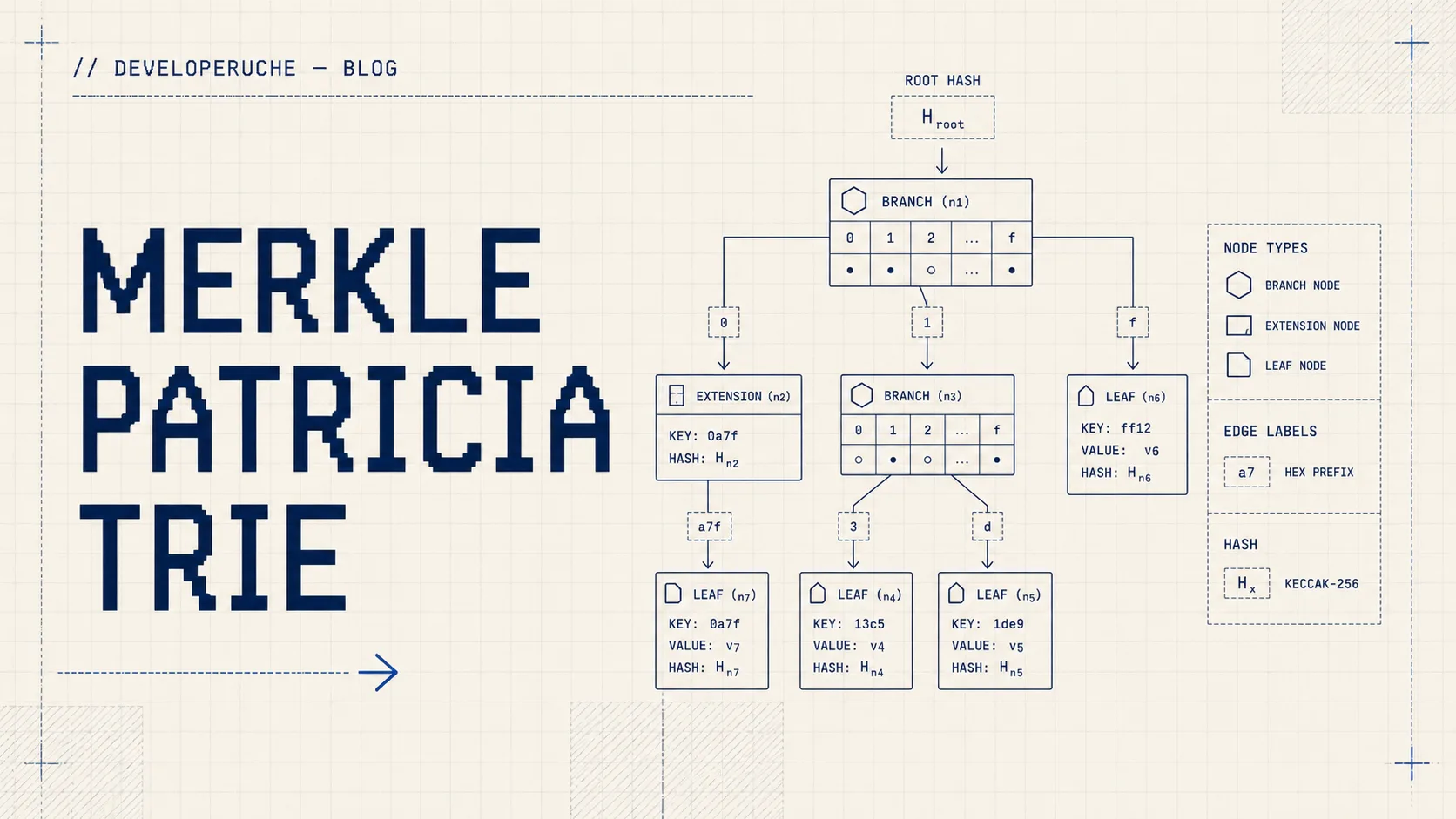
What is a Merkle Patricia Trie?
At its core, a Merkle Patricia Trie is a specialized tree-like data structure that efficiently stores key-value pairs. It cleverly combines two concepts:
- Merkle Tree: This means the structure uses cryptographic hashes to ensure data integrity. Each node in the tree is identified by the hash of its contents. The
root_hashof the entire trie serves as a unique fingerprint representing all the data stored within it. If even a single bit of data changes anywhere in the trie, theroot_hashwill change deterministically. This is crucial for systems like blockchains (e.g., Ethereum) where you need to verify state consistency efficiently. - Patricia Trie (Radix Trie): This part optimizes storage and retrieval, especially when keys share common prefixes. Instead of storing entire keys at each node, paths are compressed. Keys are broken down into smaller units (in this implementation, "nibbles" - 4-bit values), and the structure branches based on these units. Nodes only store the unique parts of the paths.
In essence: It's a secure (Merkle) and space-efficient (Patricia) way to map keys to values, producing a single hash that represents the entire collection.
Key Components in the Code:
NibbleandNibblePath: Keys are not stored as raw bytes directly in the node paths. They are first converted into a sequence ofNibbles (0-15) usingbytes_to_nibbles. A[6, 1, 6, 2]NibblePathcorresponds to the bytesb"ab". This 4-bit unit is fundamental because it dictates the branching factor (16) inBranchnodes.Db(Database): ThisArc<RwLock<HashMap<H256, Vec<u8>>>>represents the underlying storage. In a real MPT (like in Ethereum), this would be a persistent key-value database (like LevelDB or RocksDB). Here, it's an in-memory HashMap. It stores serialized node data (Vec<u8>) keyed by the node's hash (H256). TheArc<RwLock>makes it thread-safe for shared access.H256(Hash): Represents a 256-bit (32-byte) hash, calculated usingKeccak256in this code (calculate_hash_internal). Important Note: This code usesbincodefor serialization before hashing. Standard Ethereum MPTs use RLP (Recursive Length Prefix) encoding. Therefore, the hashes generated by this code will not match the hashes produced by an Ethereum client for the same data.MerklePatriciaTrieStruct: Holds the currentroot_hash(the entry point and overall state identifier) and a reference (Db) to the storage.
Node Types (Node Enum):
The structure of the trie is defined by these node types:
Node::Empty: Represents a null or empty slot. This is the state of the trie before any data is inserted, and it's also used inBranchnodes where a particular nibble path doesn't lead anywhere. It has a predefined hash (EMPTY_NODE_HASH).Node::Leaf { path, value }: Represents the termination of a key's path.path: Contains the remaining nibbles of the key path specific to this leaf, after any shared prefixes handled by parent Extension or Branch nodes.value: The actual value associated with the full key.- Example: If you insert
("do", "verb")into an empty trie, the root might point directly to aLeaf { path: [6, 4, 6, f], value: b"verb".to_vec() }.
Node::Extension { path, next_node_hash }: Acts as a shortcut for paths that don't branch.path: A shared sequence of nibbles common to all keys passing through this node.next_node_hash: The hash of the next node (which could be another Extension, a Branch, or a Leaf) where the path continues or terminates. It doesn't store a value itself.- Example: If you only have keys like
("ether", "crypto")and("ethereum", "blockchain"), you might have anExtension { path: [6, 5, 7, 4, 6, 8], next_node_hash: HASH_OF_BRANCH }representing the shared "ether" part, pointing to aBranchwhere " " and "eum" diverge.
Node::Branch { children, value }: Represents a point where a path diverges into multiple possibilities (up to 16).children: An array of 16Option<H256>. Each index (0-15) corresponds to a nibble. Ifchildren[i]isSome(hash), it means there's a child node reachable by taking the nibblei, andhashis its identifier.Noneindicates no path exists for that nibble.value: AnOption<Vec<u8>>. This allows a key to terminate exactly at this branch point.- Example (from
main): After inserting("dog", "puppy")and("do", "verb"):do->[6, 4, 6, f]dog->[6, 4, 6, 7]- They share
[6, 4, 6]. The trie might form a structure leading to aBranchnode representing the divergence after[6, 4, 6]. - This
Branchmight havevalue: Some(b"verb".to_vec())because "do" terminates here. - Its
children[7](the nibble for 'g') would containSome(HASH_OF_DOG_LEAF). TheHASH_OF_DOG_LEAFwould point to aLeaf { path: [], value: b"puppy".to_vec() }(empty remaining path as 'g' was the last nibble).
How Operations Work (get and put):
get(key)(Retrieval):- Convert the
keyinto aNibblePath. - Start at the
root_hash. - Recursively (
recursive_get) fetch the node corresponding to the current hash from thedb. - Based on the node type:
Empty: Key not found ->None.Leaf: If the leaf'spathmatches the remainingNibblePath, return thevalue. Otherwise ->None.Extension: If theNibblePathstarts with the extension'spath, consume that part of the path and recurse using thenext_node_hashand the rest of theNibblePath. Otherwise ->None.Branch:- If the
NibblePathis now empty, return the branch's optionalvalue. - Otherwise, take the next nibble from the
NibblePath, look up the correspondingchild_hashin thechildrenarray. IfSome(hash), recurse using thathashand the rest of theNibblePath. IfNone->None.
- If the
- Convert the
put(key, value)(Insertion/Update):- Convert
keytoNibblePath. - Start at the
root_hash. - Recursively (
recursive_put) traverse the trie similar toget. - When the correct position/node is reached, modify the trie structure. This is the complex part involving several cases:
- Inserting into
Empty: Creates a newLeafnode. - Inserting into
Leaf:- If keys match exactly: Update the value if different, creating a new Leaf node (with a new hash).
- If keys diverge: Replace the
Leafwith a newBranch(and potentially anExtensionif there was a common prefix). The original leaf data and the new data are placed appropriately within or below the newBranch.
- Inserting into
Extension:- If the path matches the extension fully: Recurse down to the
next_node_hash. - If the path diverges within the extension: Split the
Extension. Create a newBranchat the divergence point, and potentially a newExtensionleading to it.
- If the path matches the extension fully: Recurse down to the
- Inserting into
Branch:- If the path ends here: Update the
valueof theBranch. - If the path continues: Recurse down the appropriate child path (creating it if it's
None).
- If the path ends here: Update the
- Inserting into
- Crucially: Whenever a node is modified or created, it's serialized and stored (
store_node), generating a new hash. This new hash is returned upwards. - Parent nodes (Branches/Extensions) update their
childrenornext_node_hashwith the new hash received from the recursive call. This process repeats up to the root. - The final hash returned by the top-level
recursive_putcall becomes the newroot_hashof the entire trie.
- Convert
Example Walkthrough (from main):
trie.put(b"dog", b"puppy"):dog->[6,4,6,f,6,7]. Trie is likely empty. Creates aLeafnode, stores it, updatesroot_hash.trie.put(b"doge", b"coin"):doge->[6,4,6,f,6,7,6,5].- Traverses to the
Leaffor "dog". - Finds common prefix
[6,4,6,f,6,7]. - Replaces the
Leafnode:- A new
Branchnode is created. - The
Branchgets the value"puppy"(since "dog" terminates here). - The
children[6]slot (for the 'e' nibble) points to a newLeaf { path: [5], value: "coin" }.
- A new
- If the original "dog" Leaf wasn't the direct root, an
Extensionnode might be created/updated to point to this newBranch. - New nodes are stored, hashes propagate up,
root_hashchanges.
- Traverses to the
trie.put(b"do", b"verb"):do->[6,4,6,f].- Traverses the trie. Let's assume it encounters an
Extensionnode with path[6,4,6,f,6,7](leading to the "dog"/"doge" structure). - The path "do" (
[6,4,6,f]) diverges within this extension path. - The
Extensionis split:- A new
Branchnode is created representing the divergence point after[6,4,6,f]. - This
Branchgets the valueSome("verb")(since "do" terminates here). - Its
children[6]slot (for the next nibble 'g' in "dog") points to a new node (likely another Extension or Branch) representing the rest of the original "dog"/"doge" structure (e.g.,Extension { path: [7], next_node_hash: HASH_OF_DOG_BRANCH }).
- A new
- If the original split Extension wasn't the root, a new
Extensionnode might be created with path[6,4,6,f]pointing to the newBranch. - Again, new nodes, new hashes, new
root_hash.
- Traverses the trie. Let's assume it encounters an
This process of node creation, splitting, and hash propagation ensures the trie remains consistent and the root_hash accurately reflects its entire state after each modification.